

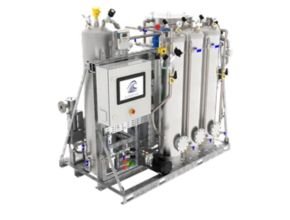
Marinfloc’s bilge water separator stands apart by using flocculation technology, delivering clean water overboard below 5 ppm, fully compliant with MEPC 107(49). With a capacity of 0.25 to 5 m³/h, it operates at low energy consumption, helping shipowners reduce CO₂ emissions while ensuring reliable bilge water treatment.
Effective Oily Water Treatment
The CD unit is a highly trusted bilge water treatment system, utilized in over 700 vessels worldwide (both newbuildings and retrofits). It features a dissolved air flotation and flocculation technology, with a capacity range from 0.25 to 5 m3/h. What sets it apart is its ability to consistently treat bilge water to below 5 ppm, ensuring compliance with MARPOL standards. Designed with onboard practicality in mind, it features an intuitive HMI screen for user-friendly operation and adaptability to diverse bilge water compositions. We also take pride in having the lowest operational expenses on the market.
At Marinfloc, we understand the challenges faced by ship operators, and we’ve recognized the issue of outdated bilge water separators. These separators, ill-equipped for today’s and yesterday’s fuels, put ship operators in a difficult position. When onboard equipment falls short of modern standards, it compromises legal compliance and environmental safety.
Our CD unit is designed with the crew in mind. The use of flocculation technology, typically employed on land to treat wastewater containing emulsions, allows the crew to effectively handle the diverse mixtures that end up in the bilges. With over 25 years of experience, our satisfied customers have demonstrated that superior performance is not just possible, but easily achievable.
Marinfloc is here to assist. Our separators are engineered to ease the burden on ship operators, providing them with the right tools for both our oceans and their business.
Bilge Water Separator Primary advantages
- Utilizes flocculation technology, eliminating the need for cartridge filters and centrifuges.
- Adaptable to treat any specific composition of a ship’s bilge water.
- Type-approved to 5 ppm with Deckma
- Designed for low energy consumption, contributing to reduced carbon footprints.
- Easy to install, easy to retrofit
- Touchscreen control cabinet available for smart functions and online connectivity
- Offers a low operational cost, ensuring value for money.
1.1 Bilge Water Separator Background
No other waste stream on a ship is so closely connected to million dollar fines and imprisonment as bilge water (engine room generated waste water). The phrase “magic pipe” is common knowledge among marine engineers and many have seen these in practice as they are still commonly used on ships. A magic pipe is a rubber hose or a pipe that is used to by-pass the vessels Oily Water Separator to discharge oil and oily water into the sea. A magic pipe can also be various manipulations of the Oil content meter or Oily Water Separator that all vessels must be equipped with. Bilge water pollution is a common problem and the Oily water separator or Oil content meter often get blamed. However, it is not as simple as that and this book addresses the combination of factors that leads to the willful illegal discharge of oily water.
1.2 Bilge Water Separator Purpose
The purpose of this publication is to inform about the various aspects of bilge water discharge to assist the maritime industry in achieving treatment systems that can produce a clean effluent overboard.
1.3 Bilge Water Separator Limitations
This book addresses regulations that apply to vessels of 400 gross tons and above; and ships less than 400 gross tons which are certified to carry more than 15 persons.
1.4 Bilge Water Separator Oil pollution and Marpol
Pollution from oil was already recognized in the 1950’s and the Convention for the Prevention of Pollution of the Sea by Oil (OILPOL 1954) was adopted 1954. However it was the Torey Canyon 120.000 ton oil spill outside Cornwall, England that really put the wheels in motion and eventually resulted in the adoption of Marpol and most of the OILPOL 1954 was incorporated into Marpol Annex I 1973/78 that came into force in 1983.
The Exxon Valdez and Erika accidents catalyzed the development of stringer rules but the largest source of oil pollution is from operational pollution and not accidents. The Resolution A.393 introduced the Oily Water Separator in 1988 and the discharge limit was 100 PPM (Parts Per Million) up until 1992 when MEPC 60(33) replaced A.393. The discharge limit was set to 15 PPM and has remained unchanged even in the 2005 update MEPC 107(49). Oil is still the only bilge water substance that is regulated. Bilge water naturally contains a full range of pollutants from dioxins to heavy metals but Oily Water Separators are not designed to remove these substances.
2.1 What is bilge water?
Bilge water can contain anything that is brought to the engine room and is not just oil and water. It is a mix of washing chemicals, rust, sewage leaks, boiler water chemicals, lubrication and hydraulic oil, foaming liquids, CIP-fluids, grey water leaks, metals, soot, bacteria, dust etc. Oil is the only bilge water substance that is regulated but far from the only harmful substance present.
The bilge water composition and volume varies from day to day and from ship to ship depending on the routines onboard, daily activi ties, trading area and what type of equipment is installed in the engine room.
2.2 Regulations and requirements
The regulations for prevention of pollution from oil originating from ships are specified in Marpol Annex I. The annex covers all aspects including certification, design, surveys etc.
However this book will deal with the bilge water discharge part of the regulation which is summarized below.
IMO regulation for discharge of bilge water :
Any discharge into the sea of oil or oily mixtures from ships of 400 gross ton and above shall be prohibited except when all the following conditions are satisfied :
Discharges outside special areas
1. the ship is proceeding en route*
2. the oily mixture is processed through an oil filtering equipment meeting the requirements of regulation 14 of this Annex;
3. the oil content of the effluent without dilution does not exceed 15 parts per million;
4. the oily mixture does not ori ginate from cargo pump-room bilges on oil tankers; and
5. the oily mixture, in case of oil tankers, is not mixed with oil cargo residues.
*“en route” means that the ship is underway at sea on a course or courses, including deviation from the shortest direct route, which as far as practicable for navigation purposes, will cause any discharge to be spread over as great an area of the sea as is reasonable and practicable
Discharges within special areas
Bilge water is not regulated in any Marpol special area apart from Antarctica and from 2017 and onwards also the Arctic, where all discharge of bilge water is prohibited as per the Polar code for vessels constructed before 1 Jan 2017. Vessels constructed before 1 Jan 2017 must comply with the Polar Code requirements by the first intermediate or renewal survey, whichever comes first after 1 Jan 2018.
Read more :