

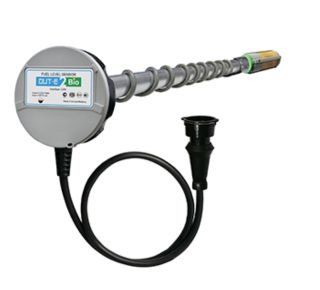
Various fuel types (summer diesel, winter diesel and especially biodiesel) have different permittivity values. That explains the difference in fuel volume measurement when capacitive fuel sensors are used. To take those differences into account, DUT-E 2Bio differential fuel level sensor is made.
DUT-E 2Bio has three measuring electrodes, what allows sensor to detect various fuel types automatically. Advantages of DUT-E 2Bio differential fuel level sensor :
- automatically detects changes in fuel composition by predefined pattern
- makes automatic correction and measure fuel volume precisely
- detects tank fill-up and fuel draining volumes
- identifies composition of fuel and indirectly evaluates fuel quality
- automatic detection of fuel type in a fuel tank.
DUT-E 2Bio is used as part of GPS tracking system, vehicle telematics and fuel monitoring systems or as a replacement for standard vehicle FLS.
Differential Fuel Level Sensor Tasks
 Monitoring of fuel tank fuelling and draining
 Fuel theft prevention
 Fuel consumption monitoring
Аdvantages of DUT-E 2Bio Differential Fuel Level Sensor
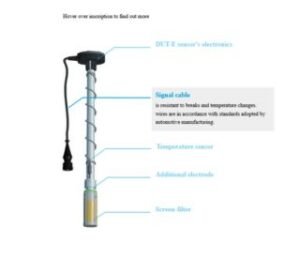
Detection of fuel type change
Third measuring electrode of DUT-E 2Bio ensures automatic detection of fuel type change. Automatic detection of fuel type makes DUT-E 2Bio useful for preventing misuse or theft of different fuel types filled in fuel tank.

Employs S6 Technology
CAN/S6 interface of DUT-E 2Bio allows to connect up to 16 sensors into a single network together with other S6-compatible equipment. Data protocol is shared, data transfer and power supply of all units occurs via a single bus cable.
Built on new IoT Burger technology
IoT Burger Technology turns DUT-E 2Bio into a smart sensor able to process and analyze fuel level data before sending to GPS tracker unit. That includes temperature correction, signal filtration and linearization, self-diagnostics of sensor’s operation. Data refining allows to get clear and precise information on fuel volume remaining in tank, refueling and fuel discharges from tank. Self-diagnostics gives possibility to detect mistakes done during installation and configuration, and choose proper way of problem resolution before coming and dismounting sensor from fuel tank.
DUT-E 2Bio S7: Innovation in fuel level measurement
DUT-E 2Bio S7 is a smart sensor that automatically adapts to changing fuel types, ensuring maximum accuracy in tank level monitoring. With built-in Bluetooth, it offers not only precise measurement but also exceptional ease of use.
★ IECEx Explosion Protection Certificate
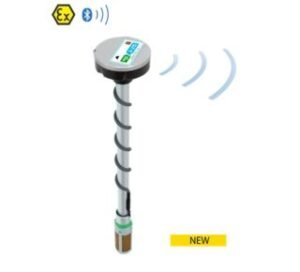
- Wireless technology : Data transmission via Bluetooth Low Energy with no need for signal cables.
- Standalone operation : Up to 5 years without external power thanks to the built-in battery.
- Rugged design for harsh environments : Reinforced housing designed for demanding conditions.
- Safe for explosive atmospheres : IECEx-certified — for use in fuel storage, on fuel tankers, at mining sites, and across other high-risk operations. The equipment is certified to IEC 60079-0 and IEC 60079-11 under IECEx Certificate IECEx FTZU 25.0021X
- Easy installation : No cabling means faster installation and lower maintenance costs.
- Full compatibility : Seamless integration with telematics systems and mobile devices across your fleet.
- Convenient configuration : Sensor setup and control via a mobile app — no PC connection required.
- BLE radio : Simultaneous data transmission to multiple receiving devices — terminal, smartphone, and tablet.
Differential Fuel Level Sensor Specification
Operation principle …………………………………………… Capacitive
Measurement inaccuracy………………………………….. ±1.0%
Supply voltage, V ……………………………………………… 10 .. 45, protection up to 100 (DUT-E 2Bio); built-in battery (DUT-E 2Bio S7)
Operation temperature, °С ………………………………. –40 .. +85 (DUT-E 2Bio); –30 .. +80 (DUT-E 2Bio S7)
Current consumption (DC 24/12V), mA …………… ≤ 25/50; ≤ 75/150 for DUT-E 2Bio CAN
Probe length, mm …………………………………………….. 700, 1000 (can be manufactured up to 6000 mm on request; up to 10 000 mm for Ø8 mm probe versions manufactured after 01.02.2026)
Output signal…………………………………………………….. CAN j1939/S6, RS-232/485 Modbus, voltage or frequency, current
Wireless data specification ………………………………… Bluetooth 5.X S7 technology — DUT-E 2Bio S7
What is the purpose of the DUT-E fuel level sensor?
The DUT-E fuel level sensor measures the fuel level and volume in the tank. Based on DUT-E readings, it is possible to determine the refueling volumes, the current fuel remaining, and the volumes of fuel drained from the tank.
What types of machinery is the DUT-E fuel level sensor designed for?
The DUT-E fuel level sensor is used on commercial vehicles and heavy machinery equipped with one or more fuel tanks. Tank shape is not a limiting factor — since DUT-E has no moving parts, it can be installed in tanks with rectangular, cylindrical, or irregular geometries.
How to use data from the DUT-E fuel level sensor?
Typically, the DUT-E fuel level sensor is connected to a vehicle monitoring terminal or a telematics gateway, which transmits the data to cloud-based GPS tracking software. The cloud software generates reports on fuel refueling volumes, refueling locations, and fuel drain volumes (e.g., theft from the tank). This information enables prompt response to improper vehicle operation, as well as detailed analysis of fuel costs and operational efficiency for individual units and the entire fleet.
Is it mandatory to connect the DUT-E fuel level sensor to a monitoring terminal?
Not necessarily. The wireless DUT-E S7 fuel level sensor transmits data via Bluetooth to a smartphone application, while the DUT-E GSM — a 2-in-1 solution — can send information directly to cloud-based software via the Internet, as well as to the user’s smartphone via SMS and email.
What is the operating principle of the DUT-E?
DUT-E is a capacitive-type fuel level sensor consisting of an outer and an inner tube, with a dielectric liquid (e.g., diesel fuel) filling the space between them. This design, with no moving parts, allows DUT-E to be used in tanks of various shapes and enables easy adjustment of the measuring section’s length.
Can DUT-E measure CO₂ emissions during engine operation?
No, DUT-E measures only the fuel level and volume in the tank. It cannot directly measure fuel consumption or determine CO₂ emissions — these tasks are handled by DFM fuel flow meters.
What is the key distinguishing feature of Technoton’s DUT-E fuel level sensors?
The Technoton product line includes four types of DUT-E fuel level sensors, each with different functionality, but all offering the following advantages :
- Transmission of up to 25 parameters — providing highly detailed fuel tank monitoring.
- Easy installation on tanks of various heights — sensor length can be freely cut or extended on-site.
- High measurement accuracy — step of measurements 0.1 mm of fuel level, ±1% error margin, and temperature correction.
- Capability to build a multi-tank monitoring system — up to 32 DUT-E units in a single network using S6 Technology.
- Durable design — no moving parts, over 20 years on the market, quality control certified to ISO 9001.
Read more : DUT-E GSM Fuel Level Sensor with GSM and GPS