
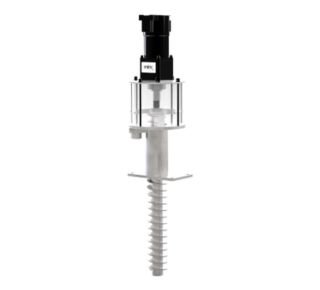
The MOS-type oil skimmer is developed for applications with many solid particles. It separates the tramp oil effectively and extends the lifetime of your cutting fluid.
The technique exploits the viscosity differential between oil and cutting fluid. The tramp oil has greater viscosity than the cutting fluid and will therefore cling to the rotating spiral. The oil is transported upwards and is continuously scraped off into a tank by a rotating metal plate that is attached to the top of the spiral.
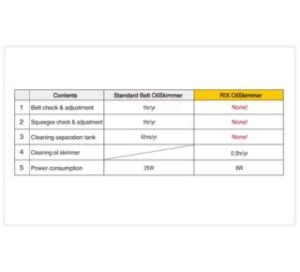
This new way of separating tramp oil is highly effective, gives you minimal loss of cutting fluids and has low maintenance requirements, low operating costs and a compact design.
The MOS-type oil skimmer has a capacity of 0.026 gal/h (100 ml/h) depending on the amount of oil and its viscosity.
| EU-standard | NA-standard |
| Application | Separation of tramp oil from the coolant |
| Mounting | Directly on the tank |
| Capacity | 100 ml/h |
| Lenght of the screw | 200 mm, 300 mm |
SCREW ACTION OIL SKIMMER
contributing factor in wear and tear in tools, loss of surface finish quality, and in particular reduced machine tolerances. If the tramp oil is not constantly separated out the cutting fluid must be continuously replaced, which will involve significant long-term costs. The tramp oil also contributes to bacterial growth in the cutting fluid that are then spread by airborne fluid particles. This can result in allergic reactions and is also a source of foul odors in the workshop environment.
maintenance costs and great efficiency – and now it’s coming to Europe.
HIGHLY EFFICIENT SEPARATION
as much oil than a traditional belt skimmer. While the screw action oil skimmer separated out 1.7 liters of
tramp oil, the result for the belt skimmer is just 0.65 liters over the same time. Unlike other
techniques such as the traditional belt skimmer, the screw action oil skimmer separates out practically all
the tramp oil while removing scarcely any cutting fluid.
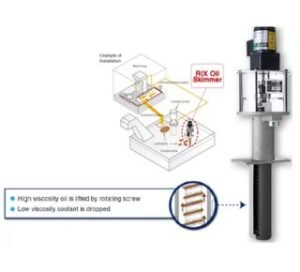
Best-Selling Screw-Type Oil Skimmer (SLS Model)
High performance
Max 0.225 gallons per hour (continuous operation)
Differentiated product range
Available in various voltages
Popularity of our products
RIX Oil Skimmers have been adopted by well-known automobile and motorcycle manufacturers since 2004
Note : The actual performance may vary from the performance described here depending on use conditions and environment.
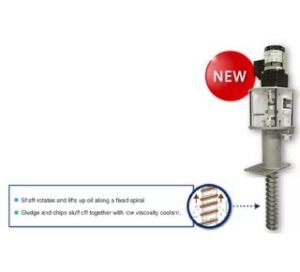
Spiral-Type Oil Skimmer (MOS-A Model)
Wider range of applications
The MOS-A model is suitable for coolant containing more sludge and chips
RIX Oil Skimmer Capacity
Max. 0.052 gallon per hour (continuous operation) is sufficient since oil usage is only 0.5 to 0.7 gallons/week.
Note : The actual performance may vary from the performance described here depending on use conditions and environment.
Advantages of RIX Oil Skimmer
1. Low Maintenance Cost
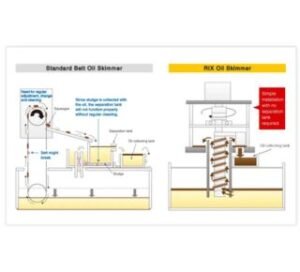
2. Reduced Waste / Disposal Cost
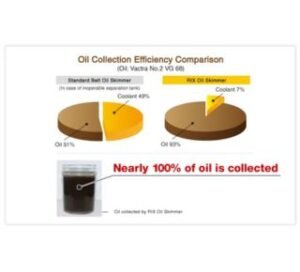
3. Space-saving
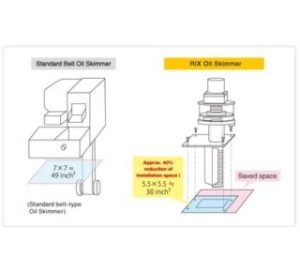
4. Low Operating Cost